Topological Constant
Objectives:
- Discover Euler characteristic of a surface.
- Determine topologically equivalent surfaces.
Materials Needed:
- Stretch Cloth or Stretch Plastic
- Scissors
- Paper
- Color Pens or Markers
Launch:
What surfaces are topologically equivalent ?
Comments:
Remember a surface is a 2-D geometrical object. It does not have any
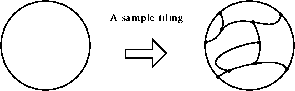
thickness. Tiling of a surface is any subdivision of the surface into
connected regions that totally cover the surface. Each region is
constructed from vertices and connected arcs. An example is the following
illustration.
Activity 1:
Cut out four circular disks from a sheet of paper. Create a different
tiling on each of the four disks.
Questions:
- Does bending, creasing, or twisting a surface change the number of
vertices on the tiling?
- Does bending, creasing, or twisting a surface change the number of
arcs on the tiling?
- Does bending, creasing, or twisting a surface change the number of
regions on the tiling?
Activity 2:
Fill in 1-4 on the following chart by counting the number of vertices,
arcs, and regions of each tiling created in Activity 1. Remember to count
arcs formed along the boundaries of the pieces.
Tiling # of vertices # of arcs # of regions
-
-
-
-
-
-
-
-
Write an equation relating the number of vertices with the number of arcs
and the number of regions for any tiling of a circular disk surface.
Activity 3:
Cut out any four shape pieces from stretch cloth. Draw a tiling on each
surface with a colored marker. Remembering to count arcs formed along the
boundaries of the pieces, add the additional data to 5-8 on the chart
created in Activity 2. Test your equation from Activity 2 using the new
data collected.
Questions:
- What is your conclusion?
- Can you deform the four surfaces by stretching, twisting, or bending
into circular disks?
Comments:
Two differently shaped surfaces are topologically equivalent if one can be
deformed into the shape of the other by stretching, twisting, or bending.
Questions:
- What can you say about the four shaped surfaces in Activity 3?
- Are they topologically equivalent to each other?
- Are they topologically equivalent to a circular disk?
- What did you notice about all the tilings in the chart?
Summary:
There exists an unique value associated with topologically equivalent
surfaces. It is called the Euler characteristic of the surface. We will
refer to this unique value with the Greek letter chi "c".
Questions:
- What is the value of c for any surface topologically equivalent to a
circular disk?
- Is a triangular disk topologically equivalent to a circular disk?
- Is a square disk topologically equivalent to a circular disk?
- Is there a shape disk that is not topologically equivalent to a circular
disk?