Rainbow Lab

Teacher Notes

Objectives

Background

The Rainbow Lab was created by Michael Huberty as one of the modules for Advantage Internet III, a collaboration between MSTA and MCTM in 1997 for integrating technology into the school curriculum. This lab is an adaptation of Circles of Light: The Mathematics of Rainbows [URL: http://www.geom.umn.edu/education/calc-init/rainbow/] created at the University of Minnesota for its introductory calculus course by Frederick J. Wicklin and Paul Edelman. The original is based on a module developed by Steven Janke and published in Modules in Undergraduate Mathematics and its Applications in 1992. The changes that have been made eliminate the need for students to derive the Law of Reflection and Snell's Law using calculus. It is recommended that you use the original lab with physics students who have a good background in differential calculus.

Prerequisite Skills

This lab requires students to be familiar with:
  • Law of Reflection
  • Snell's Law
  • Graphing and interpreting data
  • Right triangle trigonometry (including arcsine)
  • If you wish for students to derive the Law of Reflection and Snell's Law, they will also need to be able to differentiate and write basic differential equations.

    Necessary Resources

    To do this lab, students will need:
  • Computers with Internet Web access
  • Lab printouts
  • Graph paper & calculator
  • Necessary Internet Web Site

  • Build a Rainbow - for collecting data on light in water droplets
    http://www.geom.umn.edu/education/calc-init/rainbow/rainbow.cgi
  • Optional Internet Web Sites

  • Circles of Light: The Mathematics of Rainbows - the original calculus lab
    http://www.geom.umn.edu/education/calc-init/rainbow/
  • About Rainbows - excellent additional information and resources
    http://www.unidata.ucar.edu/staff/blynds/rnbw.html
  • Assessment

    The nature of this lab (difficulty and computer use) makes it ideal for students to work in pairs or small groups. The intent is for all students to successfully reach correct conclusions. The teacher may need to give additional guidance to some students to reach that goal. Students should record their data in an easy to read manner, produce accurate graphs, show the steps involved in their mathematics in a clear manner, and clearly communicate in writing the answers to the questions.


    Solutions

    Part 1 - Preparation

    Question 1
    1. The speed of light in a medium with a large index of refraction is much slower than c.
    2. Light travelling into a higher index of refraction bends towards the normal.
    3. Light travelling into a lower index of refraction speeds up and bends away from the normal.
    Question 2

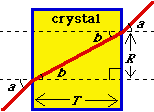
    1. See diagram.
    2. The angle of incidence is equal to the angle the light ray leaves the crystal.
    3. Set up an experiement to measure the distance, R, that the light ray travels perpendicular to the crystal's thickness, T. (See diagram.) Then the angle of refraction, b, can be calculated by b = arctan(R/T).
    Question 3
    1. b(45° + 5°) = 18.52°.
    2. b(50°) = 18.45°. The estimate has an absolute error of 0.07° and a relative error of 0.38%.
    3. b(45° + 20°) = 23.10°. b(65°) = 21.99°. The estimate has an absolute error of 1.11° and a relative error of 5.05%.


    Part 2 - Simulating a Rainbow

    A sample printout of the rainbow simulation is included at the end of the Teacher Notes.

    Experiment #1

    Experiment #2

    Experiment #3

    1. With a wavelength of 400 nm the deflection angle has the same behavior as before, only the deflection angle is slightly larger. The minimum deflection angle of 139.6° occurs again at w = 0.86 and a = 59°.
    2. As the wavelength of light decreases, the minimum deflection angle increases.
    3. For w = 0.9:
      WavelengthDeflection Angle
      400 nm140.3°
      450 nm139.7°
      525 nm139.1°
      580 nm138.7°
      625 nm138.5°
      700 nm138.3°


    Part 3 - Analysis of the Experiment

    Question 4

    Question 5

    1. D(0) = 180°. Since the light ray enters the water droplet along the normal, it does not bend. Upon hitting the other side of the droplet, the reflected ray returns along the same path, only the opposite direction (180° deflection).
    2. The sketch of D(a) for 0° < a < 90° will decrease to a minimum value and then increase.
    3. The limit of D(a) as a approaches 90° depends on the wavelength. For a wavelength of 700 nm the limit is about 165.4°. For a wavelength of 400 nm the limit is about 167.9°.
    4. The minimum of D(a) on the sketch occurs at the previously calculated a = 59°.

    Question 6

    1. The tightest possible output beam will occur when the relative change in deflection is minimized.
    2. The tightest possible output beam will occur when a0 = 59°.

    Question 7

    1. The light ray is deflected the following amounts:
      Across Point A a - b
      At Point B 180° - b
      Across Point C a - b
    2. D(a,b) = 180° + 2a - 4b.
    3. b = arcsin[sin(a)/n].
    4. D(a) = 180° + 2a - 4arcsin[sin(a)/n].
    5. The rainbow angle for red light is approximately 138°.


    Part 4 - Conclusions

    Question 8

    Question 9